
Is document processing your data sovereignty blind spot?
Depending on precisely how your cloud infrastructure is set up, your data could fall under dozens of countries’ laws. Is your organization prepared to deal with the potential fallout of that? This isn’t a theoretical concern — it’s a growing compliance issue, as regulations increase and geopolitical pressure reshapes what “trusted infrastructure” means.
For companies in regulated sectors, potential data exposure through these avenues is rarely obvious. It’s hidden in workflows outside of the core compliance perimeter, with document conversion, OCR, and similar processes often crossing infrastructure boundaries. Sovereign cloud infrastructure is how many organizations are bridging the gap. It grants access to modern, scalable cloud capabilities, while maintaining strict guarantees over where data lives, who can access it, and under which jurisdiction.
How many countries' laws does your data fall under?
Questions like that are a huge driving factor in companies prioritizing data sovereignty. For example, under the United States CLOUD Act, a U.S.-based provider can be forced to share data with law enforcement, whether the data is physically stored in the U.S. or not.
What happens when the company using that cloud provider isn’t in the U.S., and is subject to conflicting laws around what can be done with their data and who it can be shared with? When data falls under multiple jurisdictions due to multinational infrastructure, data sovereignty doesn’t exist. And when some vendors have operations in dozens of countries, the question of who has jurisdiction and when can get complicated, to say the least.
By contrast, a sovereign cloud keeps all data under one specific jurisdiction, like Germany, the United States, or China. And all data means all data — compute, backups, metadata, API logs, billing records, stored data and archives, etc. — whether it’s at rest, in transit, or being processed. With true data sovereignty, cloud infrastructure is also managed end-to-end by teams within the same jurisdiction. From support tickets to security issues, it’s all done by a team operating under the same laws that your data is covered under.
In addition to data residency and jurisdictional control, the third differentiator between sovereign cloud infrastructure and standard cloud infrastructure is auditability. Every part of the infrastructure and its processes, from subprocessors to hardware to data access management, should be documented, with the ability to be inspected and verified by authorized parties.
All of these concerns apply both broadly and to specific data processes. Organizations often assess data sovereignty at the infrastructure level — where data is stored and which laws govern it. In doing so, they often miss individual workflows that can create jurisdictional exposure.
Document processing is ripe for this kind of data leak: every conversion, normalization, OCR process, and archiving step creates a data trail involving transformation logs, intermediate file states, metadata, and other types of data. And all of that data falls under the same residency requirements as the source document. If any part of that process involves infrastructure outside the defined jurisdiction, the promise of data sovereignty is an illusion.
Where sovereign cloud changes the compliance calculus
For organizations in highly-regulated sectors, these differences aren’t theoretical — they’re directly related to audit exposure and operational continuity. They’re also necessary in demonstrating compliance to regulators who are operating under increasingly specific rules about where data is processed (not just where it’s stored).
The three areas where sovereign cloud infrastructure most dramatically changes the compliance calculus are:
Jurisdictional control
Regulatory positioning
The operational cost of achieving compliance
All data under one jurisdiction
We’ve already touched on this, but it’s worth reiterating, especially for organizations doing any form of government contracting. Geopolitical pressures and risk turn supply-chain issues into a serious concern when data is potentially subject to foreign intelligence laws. Depending on the provider, you may even be able to restrict access to the infrastructure to personnel with a specific nationality and clearance status.
If you’re in a country with strict data residency laws, sovereign cloud infrastructure is likely one of your only alternatives to on-premise deployment. For example, in DACH countries, data residency requirements prevented cloud-based document processing, which meant organizations had to use on-premise tools to stay compliant. Sovereign cloud infrastructure creates another option that lets companies modernize their workflow, without creating legal and security risks.
Get ahead of increased regulatory pressure
In general, regulations around data (and specifically data residency) have only been getting stricter, and that trend seems poised to continue. Sovereign cloud infrastructure offers organizations in heavily-regulated industries a way to get the benefits of modern infrastructure, without introducing new compliance risks, and while staying ahead of the regulatory curve.
As regulations around data storage and access continue to get stricter, this issue will only become more pressing for companies who want to stay compliant and preserve their customers’ trust. As-is, the existing legal framework of EU data protection is clear that organizations dealing with personal data must be able to show compliance with strict residency and processing requirements. If your organization is EU-based and you’re using infrastructure that falls under non-EU jurisdiction, you’re potentially exposing yourself to legal risks and the accompanying fines.
Simplified compliance posture, that goes above and beyond “just” compliance
When your organization requires infrastructure that inherently aligns with GDPR, national security requirements, or industry regulations, sovereign cloud infrastructure significantly simplifies compliance. With it, these constraints are embedded into the infrastructure itself — there’s no need for additional management, configuration, or customization just to reach the basic compliance requirements you need.
At the same time, sovereign cloud infrastructure goes above and beyond the table stakes of meeting compliance requirements to offer the following benefits:
Lower latency: As a side effect of the data centers being closer to users, sovereign cloud infrastructure often reduces latency and improves reliability, while offering more control over the tech stack as a whole.
Stronger customer trust: Customers are becoming increasingly aware around issues of digital safety and security. One 2024 study showed that 77% of respondents had concerns over data handling, and 82% of respondents favored brands that communicated data practices clearly. Being able to tell customers exactly where their data is stored and assure them that it never leaves the country can be a valuable differentiator.
Operational resilience: When a global provider is disrupted, sovereign infrastructure means that your operations aren’t affected by failures outside of your jurisdiction. You’re not waiting on a hyperscaler’s incident response timeline for systems halfway around the globe, that have nothing to do with your own environment.
See it in action: Conversion Service on IONOS Cloud
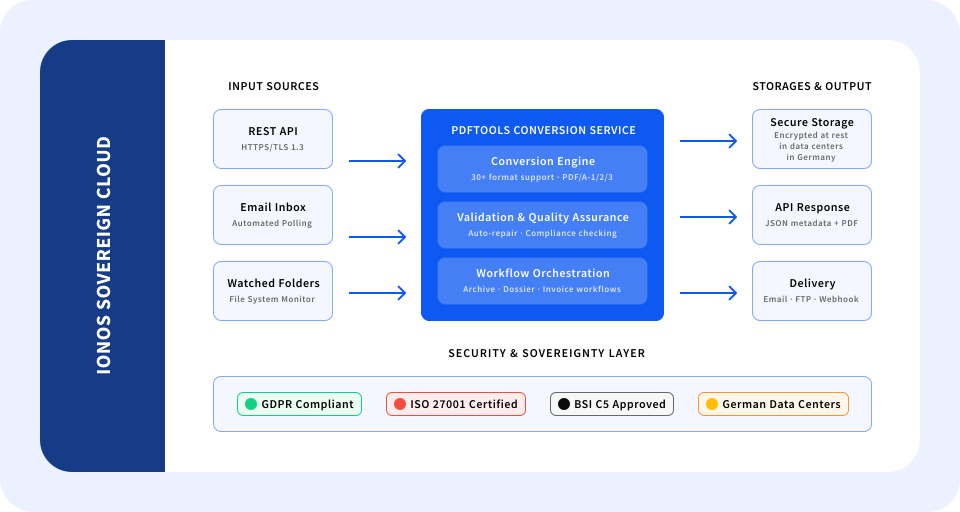
Our Conversion Service is built to run wherever your compliance requirements need it to — on-premise, in the cloud, or with hybrid deployment. In the highly-regulated countries and industries our customers work in, they’ve been forced to choose between the compliance benefits of on-premise deployment and the operability of working in the cloud. Now, we have a new option that removes that choice from the equation. For organizations that need sovereign cloud deployment, we’ve partnered with IONOS, a leading German provider of sovereign cloud infrastructure, to give our customers the option of deploying our Conversion Service on the sovereign cloud.
Data sovereignty isn’t just about where documents are stored; it’s also about having the entire document processing chain within the same jurisdiction. Having that level of control also makes the documenting processing chain auditable, with every transformation step and intermediate output made traceable and jurisdiction-bound. We provide this level of auditability by combining deterministic processing with a documented transformation history.
With this partnership, customers can skip on-premise deployment and access scalable document conversion with a preconfigured setup on secure European data centers. IONOS services are fully hosted in Germany with complete data residency, built from the ground up to be GDPR-compliant and ISO 27001/BSI C5 certified.
Rebuilding your infrastructure from the ground up with a focus on data sovereignty can be a daunting project. By starting with an area that’s ripe for security leaks — document processing — your organization can adopt modern workflows, while ensuring your data and infrastructure remain within trusted European jurisdiction. If you’re ready to prioritize data sovereignty in your document conversion workflows, head here to learn more.